


Commercial HVAC Installation in League City, TX
Sized for Gulf Coast Moisture Load
Licensed Since 1976 | No Overtime on After-Hours Work
Commercial HVAC Installation in League City, TX
Commercial HVAC installation is the design, sizing, and mounting of a heating and cooling system for a business property, and in League City the job is decided by how the system handles moisture rather than how much cold air it makes.
At Vanderford Air and Plumbing, we are a licensed Texas air conditioning and refrigeration contractor serving League City and Galveston County, and the complaint we fix most often on someone else’s commercial install is a building that hits its setpoint and still feels damp. A commercial system on the Gulf Coast has to pull water out of the air first and drop the temperature second.
Contact us online when you are ready to improve your building comfort.
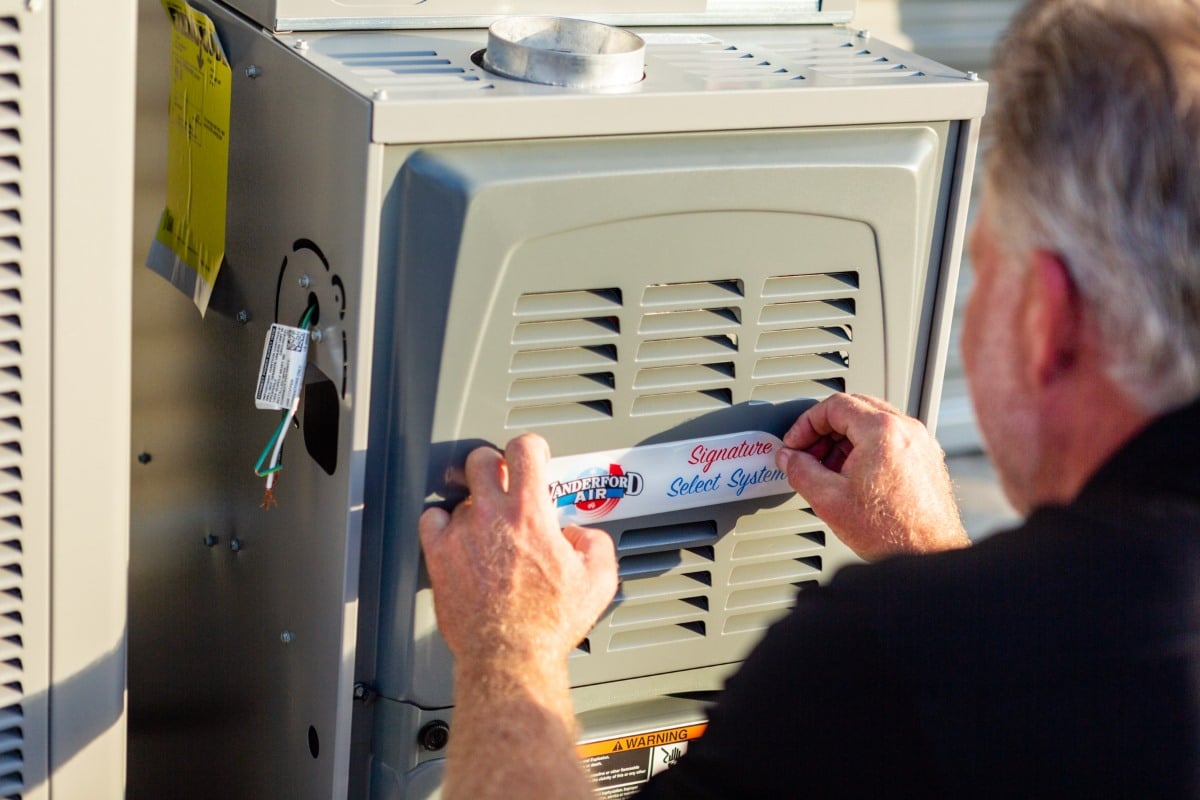
Licensed for Commercial Mechanical Work in League City
Vanderford Air and Plumbing holds Texas air conditioning and refrigeration contractor license TACLA21258C from the Texas Department of Licensing and Regulation, issued under Chapter 1302 of the Texas Occupations Code and valid for commercial work in League City, Dickinson, Friendswood, and the surrounding Clear Creek communities. We have been family-owned here since 1976, now second-generation, and we price commercial work up front.

Signs Your League City Building Needs a New Commercial System
Commercial equipment rarely fails without warning. It degrades, and the building tells you first.
- Occupants say the space is cold and clammy at once, which means the system is removing temperature but not moisture
- Condensation forms on supply diffusers, interior glass, or ductwork, so those surfaces sit below the indoor dew point
- Musty odor at startup, or visible growth around diffusers and in the return path
- The unit short cycles, running in bursts too brief to pull humidity out of the air
- The system was sized for a different use than the space has now, common in League City retail and office suites after a tenant change
How We Install Commercial HVAC Systems
We start with a load calculation, not a nameplate. Matching the tonnage of whatever is on the roof today repeats whatever mistake was made last time, and in this climate that mistake is almost always oversizing.
- Site and load assessment. We measure the conditioned area, occupancy, plug and lighting load, glazing, orientation, and how much outdoor air the space needs. Sensible and latent loads are calculated separately, because here they are very different numbers.
- Equipment selection against the load. We select from AHRI-certified ratings so the capacity we specify is the capacity you get, and we check part-load performance rather than only full output.
- Structural and electrical check. Rooftop units need a curb and a roof that can carry them. We confirm structural support, service capacity, and the disconnect before ordering.
- Ductwork and airflow. We check static pressure and duct conditions. A correctly sized unit on undersized ductwork will not perform, and this is where commercial installs fail.
- Permitting and inspection. League City requires a permit for air conditioning equipment replacement, and mechanical work falls under the 2021 International Mechanical Code as adopted by the city at section 22-241 of its code of ordinances. We pull the permit and meet the inspector.
- Installation and commissioning. Set, connect, evacuate, charge to the manufacturer specification, and verify. We check superheat and subcooling, measure supply and return conditions, and confirm the condensate path drains before handing the system over.
Why Gulf Coast Dew Point Drives Commercial HVAC Sizing in League City
Commercial systems in League City feel wrong even when they hold temperature because the outdoor air here carries an enormous amount of water, and a commercial building is required to bring that air inside.
NOAA hourly climate normals for Houston William P. Hobby Airport, the nearest first-order station to League City, put the mid-July dew point between 72.0 and 75.4 degrees across the day. Dew point is the absolute measure of moisture in the air, and a 74-degree dew point is a heavy moisture load by any national standard.
That matters more in a commercial building than in a house. Ventilation standards, ASHRAE Standard 62.1 among them, require commercial spaces to bring in outdoor air continuously for occupant health. Every cubic foot of that air arrives at roughly the outdoor dew point, and the system has to condense that water out before the space feels comfortable. That is latent load, and it is invisible on a thermostat.
The failure mode follows from there. A unit sized on sensible load alone, or sized to the biggest tonnage that fits the curb, satisfies the thermostat quickly and shuts off. Short run times mean the coil never stays cold long enough to condense much water, so indoor humidity climbs while the air temperature reads fine. The EPA advises keeping indoor humidity below 60 percent, ideally between 30 and 50 percent. We calculate latent and sensible load separately, and where the space needs it, specify dedicated outdoor air handling rather than asking one rooftop unit to do both jobs badly.
What Affects the Scope and Cost of a Commercial Installation in League City
We price every commercial job after the site assessment, because these variables move the number more than tonnage does:
- Conditioned square footage, ceiling height, and how the space is partitioned
- Occupancy and use type. A restaurant, a medical suite, and a warehouse carry very different loads
- How much outdoor air the space requires, which drives the latent capacity you need
- Rooftop package versus split system versus ductless, and whether a new curb is required
- Condition of the existing ductwork and whether static pressure needs correcting
- Refrigerant availability, since new light-commercial equipment has been limited to refrigerants below a 700 global warming potential since January 1, 2025
- Permit and inspection requirements through the League City building department
- Whether the work has to happen outside business hours, which we do not surcharge
Why League City Businesses Choose Vanderford Air and Plumbing
- Family-owned and operating in Galveston County since 1976, now second-generation
- Licensed Texas air conditioning and refrigeration contractor, TACLA21258C, and insured
- Load-calculated sizing rather than a tonnage match to the old unit
- Upfront pricing agreed before installation begins
- No overtime charges for after-hours or weekend commercial work
- One contractor for the mechanical and the plumbing side of your building
What League City Customers Say About Our Commercial HVAC Installations
Many of our League City customers describe what a building owner is buying when they choose a mechanical contractor.
They arrived when they said they would. Completed examination and detailed estimate for repairs quickly. Very professional yet friendly.
Mike Kiser. On a commercial job that estimate follows the load calculation, so the number you agree to is built on measured conditions rather than the tonnage of the unit being replaced. Read this review on Google.
Vanderford knows what they are talking about! Gives reasonable quotes and outstanding high-quality work. Their plumbers and HVAC technicians are professional, knowledgeable and honest.
Philip Durrschmidt, another business owner. One contractor covering the mechanical and the plumbing side of a building is a practical advantage when a tenant needs both. Read this review on Google.
Related Commercial Services in League City
If your building already has equipment that is underperforming, start with our commercial HVAC services page, or see the full range of work we do for commercial properties. For everything else we handle in this city, see our League City service page.
Schedule Your League City Commercial HVAC Consultation
We install commercial heating and cooling systems for offices, retail suites, restaurants, medical practices, and light industrial buildings throughout League City and Galveston County. Every installation starts with a load calculation and an upfront price. Schedule service online and we will set a site assessment around your hours.