


How Do I Know My AC Needs Repair? 7 Warning Signs in Houston Bay Area Homes
Your AC needs repair if it blows warm air, runs constantly without reaching the thermostat setting, makes grinding or squealing noises, leaks water, smells musty, short cycles, or drives your electric bill up with no change in how you use it. On the Texas Gulf Coast, a system that does any of these in June is already on borrowed time. Here is how to read each sign and what to do about it.
Why does my AC blow warm air?
Warm air from the vents is the most common call we get in July and August. The cause is usually one of a few things: a dirty air filter choking airflow, a frozen evaporator coil, a failed capacitor or contactor at the outdoor unit, or low refrigerant from a leak.
Start with what you can check safely. Look at the thermostat to confirm it is set to cool and the fan is on auto. Check that the breaker has not tripped. Pull the filter and hold it to the light. If you cannot see light through it, replace it. The U.S. Department of Energy reports that swapping a dirty, clogged filter for a clean one can lower an air conditioner’s energy use by 5 to 15 percent, so this is worth doing even when the AC is working.
If you see ice on the refrigerant line or the indoor coil, turn the system off and let it thaw. Ice means airflow or refrigerant is off, and running a frozen system can damage the compressor. Refrigerant work requires EPA 608 certification, so that part is not a do-it-yourself fix.
What does weak airflow from the vents mean?
When the air coming out is cool but weak, the problem is usually restricted airflow rather than cooling. Common causes are a clogged filter, a failing blower motor, a dirty evaporator coil, collapsed or disconnected ductwork, or closed registers.
Ductwork deserves attention in this region. ENERGY STAR notes that a typical home loses 20 to 30 percent of the air moving through its duct system to leaks, holes and poorly connected sections. Many Houston Bay Area homes have ducts running through a hot attic, so a leak there sends cooled air into a scorching attic instead of your living room. A technician can test airflow and find where it is escaping.
Why is my AC making strange noises?
Each sound points to a different part:
- Grinding or scraping: worn motor bearings or a failing blower wheel. Turn the system off.
- Squealing: a belt or motor bearing problem, depending on the equipment.
- Rattling: loose panels, debris in the outdoor unit, or a loose fan blade.
- Clicking at startup that repeats: often an electrical component, such as a relay or contactor, that is struggling.
- Buzzing from the outdoor unit: a capacitor or contactor problem, or a fan motor that is not starting.
Any of these gets worse with time. A part that costs little to replace now can take out a compressor if the system keeps running, so call early.
Why does my AC smell musty or leak water?
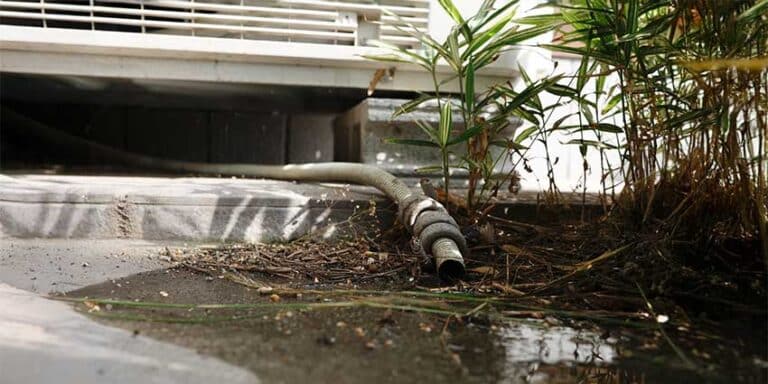
Gulf Coast humidity makes this one common. Your AC pulls a lot of moisture out of the air, and that water leaves through the condensate drain line. When algae and debris clog that line, water backs up into the drain pan, then onto the attic floor or the ceiling below. Many systems have a safety switch that shuts the unit down when the pan fills. If your AC stops and you find water near the air handler, check for a clogged line.
A musty smell tells you moisture is sitting somewhere it should not. It can come from a dirty coil, a damp drain pan or mold growth in the ducts. Cleaning the coil and line often solves it. If the smell returns, it is worth looking at humidity control, and our guide to the ideal temperature and humidity for a Houston home explains what indoor levels to aim for.
Why does my AC turn on and off every few minutes?
Short cycling means the system reaches a trigger point and shuts off before completing a normal cycle. It is hard on the compressor and does a poor job removing humidity, which leaves the house cool but sticky. Causes include an oversized system, a dirty filter or coil, a bad thermostat, a refrigerant problem, or a failing component. Because the causes overlap, a technician has to measure the system to find the real one.
Why are some rooms hotter than others?
Uneven cooling is common in two-story homes and in homes with additions, because heat rises and ducts were often sized for the original house. Upstairs bedrooms that stay warm can point to leaky ducts, poor attic insulation, a dirty coil or a system that is too small for the load. It can also be a design issue where one thermostat controls a home with very different zones. Our page on zone control systems covers one way to even out temperatures when the equipment itself is sound.
Why did my electric bill jump?
If the bill rises and your habits have not changed, the AC is a likely cause. A dirty coil, a failing motor or low refrigerant makes the system run longer to do the same job. On a Texas summer bill, efficiency problems in the AC show up quickly.
Compare this month’s bill to the same month last year, not to last month, since July and August will always cost more than May. If the gap is large, schedule a diagnosis. Regular AC maintenance is the simplest way to keep efficiency from slipping.
Should I repair my AC or replace it?
That depends on the age of the system, the condition of the major parts and the type of refrigerant it uses. A repair makes sense when the problem is a single part and the rest of the system is in good shape. Replacement is worth discussing when failures are piling up, the compressor or coil has failed, or the system is well past the point where parts are easy to find. We lay out the factors in repair or replace your AC, and a technician can give you a straight answer after seeing the unit. If you decide to replace, look for the ENERGY STAR label, which marks equipment that meets federal efficiency guidelines.
What should I do while I wait for the technician?
- Set the thermostat to off if the unit is frozen, leaking or making loud noises.
- Replace a dirty filter.
- Clear leaves and debris from around the outdoor unit with the power off.
- Close blinds on sun-facing windows to slow the heat gain.
- Write down what you noticed and when. Sounds, smells and error codes help a technician find the problem faster.
Who can I call when my AC stops working?
Vanderford Air & Plumbing has served the Houston Bay Area since 1976. We are a licensed Dickinson company with NATE-certified technicians, and we offer 24/7 and same-day service. Learn more about AC repair or call (281) 344-2925 to schedule a visit.